

IMS Versi-Dredge – Self-Propelled Dredges
If you find yourself answering YES to these questions, then the Versi-Dredge is the right dredge for your operation. Do you want a dredge that…
- is self-propelled and reduces operating costs by eliminating additional labor and equipment required for setting up swing wires, travel cables, and anchors?
- is going to produce more than the competition and reduce your operating costs by getting you to your next project faster?
- is durable enough to deepen the Tigris River, mine frac sand in the blistering North Dakota winter, or just deepen a midwestern residential lake or marina?
- is easy to operate with all dredge functions integrated into robust dual joystick controls?
- can cut and pump sand and sediments and then with a switch of a cutterhead can cut and pump 9 ft. tall reeds and cattails several thousand feet away?
- has the maximum dredging depth in its class all while staying one truck transportable?
- reduces downtime by up to 90% in debris rich environments where other dredges will clog regularly?
- is built to last and is designed with anti-corrosion in mind including 316 stainless steel hydraulic fittings, hardware, and ladder lines?
- is repeatedly purchased by some of the biggest names in the U.S. inland dredging industry as well as governments overseas earning it the U.S. President’s E-Award?
- is manufactured in the most modern dredge manufacturing facility in the United States that is ISO:9001 certified and backed by a Fortune 500 Company?
- has unmatched customer support and parts readily available on the factory shelf?

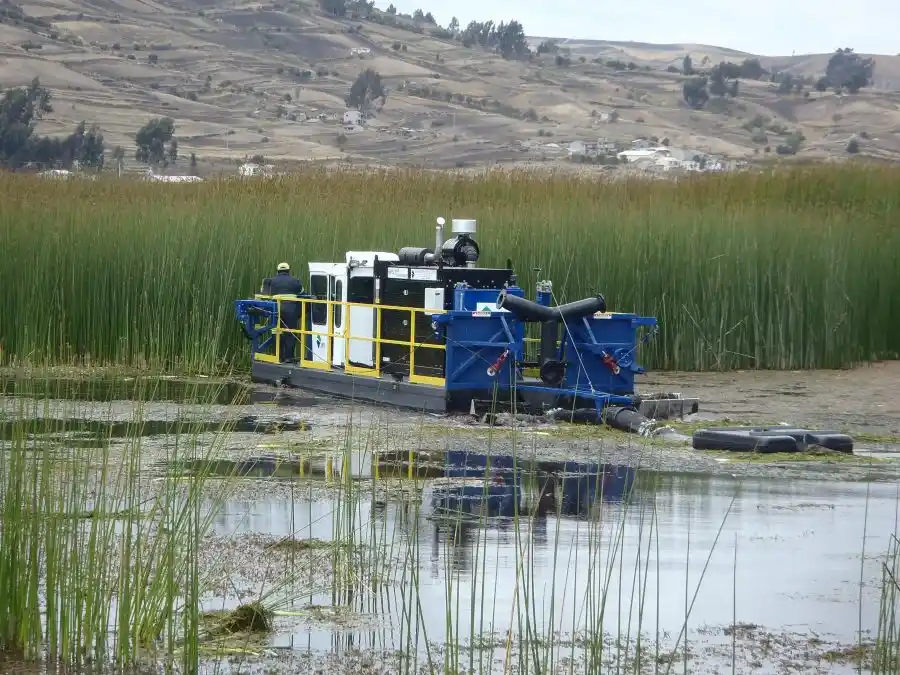
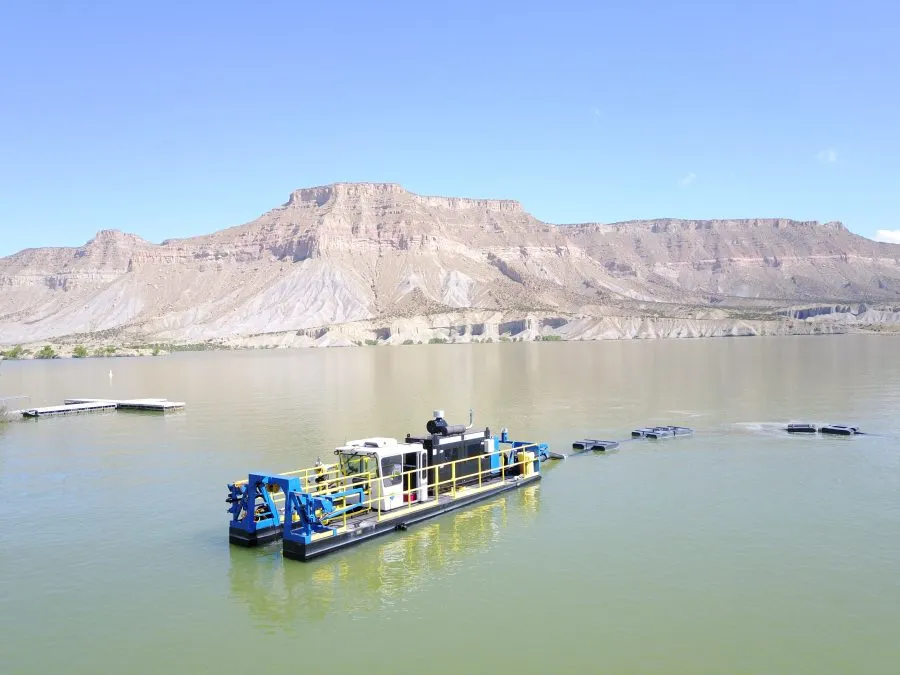

All IMS Versi-Dredge models come standard with the patented Starwheel Drive® self-propulsion system which eliminates the need for anchor cables, swing wires, dredge tender boats, and additional labor to help position the dredge significantly reducing hourly operating costs. The costs associated with 2-3 additional employees and fuel for work boats can make a dredging operation less efficient and be the difference between winning and losing a bid. The Starwheel Drive® self-propulsion system consists of two independently driven Starwheels that are raised and lowered to the bottom of the waterway. They are variable speed and bi-directional. The Starwheel Drive® system operates in two different functions:
Surface Propulsion: On the surface the Starwheels are used as a high-speed paddle wheels allowing the dredge to move easily from point A to point B or to dredge in light silts and sludges without causing turbidity. The Starwheels can also be used on the surface in large cement or polyethylene lined lagoons where cable rigging is not possible due to larger dimensions of the ponds (exceeding 1,000 ft. width). In cases like these the Starwheels run on the surface and the cutterhead can be outfitted with liner protection wheels.
Bottom Propulsion: When dredging in more consolidated muds, sediments, and sand the operator can lower the Starwheels to the bottom surface. Once the wheels are lowered past the water surface line the patented TractionMaster ® technology automatically switches to bottom propulsion mode lowering the rpm range based on the operator’s desired cutting speed. Bottom propulsion mode allows the operator to achieve positive traction drive and slowly push the cutterhead into the material to maximize solids and minimize turbidity while keeping the dredge positioned. Propeller driven dredges do not have the force to effectively operate in consolidated materials and sand and must therefore use their optional cable drive systems instead. This is why IMS is the global leader in the self-propelled dredging market. This is also why we replace prop dredges regularly.
Starwheel Drive® allows the dredge to effortlessly maneuver into coves, large open areas, and berths without resetting anchor wires or underwater anchors using an additional tender boat. Since the dredge has no spuds, it can easily maneuver under structures and bridges. No tender boats are required to reposition the dredge meaning you only need one operator to control the mobility of the dredge. Additionally, Starwheels will not clog like prop driven dredges do in environments where there is a lot of debris or aquatic vegetation.
The patented Starwheel Drive® and patented TractionMaster® technology are proven worldwide, and many customers have owned 2,4,6 and sometimes 10+ units. No other propulsion system on one truck transportable dredges is as effective as the Starwheel Drive® system.
All IMS Versi-Dredge models come standard with the SolidsMaster™ cutterhead for hydraulically dredging sand, mud, tailings, and other underwater sediments. The material is cut and mixed with water to create a pumpable slurry by the SolidsMaster™ and then sent to the discharge area via a closed pipeline. The SolidsMaster™ is a horizontal cutterhead that uses heavy duty carbide steel replaceable trencher teeth to rip through the material and convey it to the pump inlet. Since the pump on all IMS units is ladder mounted directly behind the cutterhead, the material is pumped at up to 5%+ higher solids than basket / conical type cutterheads. Additionally, the SolidsMaster™ has a full-length low turbidity shroud which in addition to lowering turbidity in the dredging zone acts as a vacuum to help convey higher solids than open cutterheads. IMS’s proprietary SolidsMaster™ cutterhead also has a proprietary auger motor sleeve to protect the motors from seal failure. This technology is not used by other auger dredge manufacturers.
The Versi-Dredge is designed to work in a variety of applications including: beach dredging, canal dredging, lagoon dredging, lake / reservoir dredging, marina / port dredging, mine tailings dredging, river dredging, sand mining / dredging, spray dredging, and vegetation dredging.
In addition to hydraulically dredging sediments, the Versi-Dredge does something no other dredge in the world can do and that is it cuts vegetation into pumpable pieces that are discharged up to several thousand feet away via closed pipeline. IMS’s optional patented WeedMaster® cutterhead technology converts the dredge into a hydraulic weed harvester that can continuously cut and pump vegetation to shore without having to stop to switch hoppers or go to shore to empty a payload which then must be handled by an excavator. This significantly reduces operating costs by eliminating an additional workboat, additional diesel engine, and additional labor that conveyor type harvesters or amphibious dredges require. The Versi-Dredge with the patented WeedMaster® is completely self-propelled and can cut and pump vegetation continuously allowing for higher production rates in challenging environments. The WeedMaster® can cut and pump cattails, reeds, hyacinths, hydrilla, milfoil, water lilies, sargassum, and large mixed vegetation mats. No other dredge in the world has this capability.
All Versi-Dredge models are one-truck transportable when fully assembled which means they are launched with a single crane. There are two lifting points on port and two lifting points on starboard which allow an appropriately sized crane with a 4-point spreader to launch and retrieve the dredge safely to and from the water.
Some clients will opt for IMS’s Transport – Launch – Retrieve (TLR) Trailer™ which can transport the dredge to the site, launch the dredge from a boat ramp or safely graded shoreline, and retrieve the dredge to go to the next job. The IMS TLR Trailer™ has keel guides, a remote-controlled winch, deck roller wheels which recess for transport, and a hydraulic tilt design for easy launching. The TLR Trailer™ is ideal for contractors and municipalities that wish to frequently move the dredge from site to site to reduce transport and launching expenses over time.
All Versi-Dredge models are engineered to be the most versatile, productive, and deepest digging in their respective class. The 7012 HP Versi-Dredge for example can out produce any one truck transportable ladder dredge and maintain a higher level of productivity and cutting depth all while fitting on one truck without disassembling. IMS Versi-Dredge models achieve maximum efficiency for their physical size.
All Versi-Dredge models are designed with productivity and performance in mind and that starts with all of the dredge pumps used on Versi-Dredge models having certified pump curves from GIW’s state of the art slurry lab in the United States. The pumps are ladder mounted and perform at rates of 3,500gpm to 5,000gpm (795m3/hr.-1,136m3/hr) depending on the model. Due to the position of the pump and the powerful horizontal cutterhead mounted in a vacuum type low-turbidity shroud, consistently higher solids are achieved. Versi-Dredge models have the highest production in their size range for one truck transportable dredges. Since you don’t need to mess with traverse cables you can spend more time dredging and less time hammering anchor plates into the ground or picking up and repositioning anchors with a tender boat.
What should I avoid?
Hanging Pumps: Avoid pumps that are disguised as a “dredge”. You cannot just put a pump with agitators or a jet ring on a small barge and expect to effectively dredge. There is no shape to the cut and how do you track your progress? If you drag the pump into the material then you risk snapping your cable and spilling hydraulic fluid. If you raise and lower the pump constantly into the material then you are creating a bunch of holes in the material and once the pump is lifted out it is not engaged so your theoretical production is drastically reduced because you are not being productive anymore. The CAPEX might look better additionally, but you are going to pay for it on the OPEX side with more time on site, more labor, more labor hours, re-dredging the same areas again, etc. The lesson is to buy it once and buy it right. Also, ask the supplier to explain the real production numbers. Are they in solids by volume or solids by wait? What efficiency are they quoting you? This will give you an accurate comparison of production numbers so you can make the right choice. Too often we hear of people quoting in solids by weight when people are expecting solids by volume. Additionally make sure you are getting real world efficiency numbers and not 100% which is theoretical.
Amphibious Dredges: You are paying for a lot of equipment that you don’t need. This is why amphibious dredges have not made a huge impact in the U.S. market after decades of foreign suppliers trying to penetrate the market. They are more than double the price of the largest Versi-Dredge and are less productive than one. This makes it hard for you to be profitable. It is a Jack of all trades, but master of none. Do you want to go into your dredging project being able to remove a weed cover and then dredge 100,000 cubic yards of sediment with a higher production machine like a Versi-Dredge or do you want to have a machine that can crawl down the bank and has a pile driver attachment, but much lower production pump which will keep you on site twice as long?
Propeller Driven Dredge: If the dredge you are looking at has a propeller as its primary means of propulsion, then be prepared to use a cable drive system once you get beyond dredging loose sludge as props cannot effectively dredge sand or consolidated materials like Starwheel Drive® can. Also, the pumps and cutterheads on these dredges are notoriously weak and clog due to their design. For these reasons, IMS has replaced many of these dredges with Starwheel Drive® Versi-Dredge units. Here are two examples:
It is common to run across cans, bottles, plastics, and other debris in rivers, lakes, and canals around the world when dredging. This is why IMS includes the patented Pump Defender® self-cleaning debris guard on every single Versi-Dredge it manufactures. The Pump Defender® is an advanced version of a cutterhead debris screen that is designed to allow uninterrupted flow of material to the slurry pump while the cutterhead cleans it after every revolution. The cutterhead on the Versi-Dredge rotates 1 revolution per second, so every second the Pump Defender® is cleaned to ensure maximum flow and minimize downtime. The Pump Defender® is proven around the world in debris rich environments where other hydraulic dredges would clog up and fail. Before the Pump Defender® a dredge would stop every hour for cutterhead clean-outs and after it would be maybe once or twice a week if that. This is a significant technological breakthrough in the dredging industry because to clear a cutter requires the dredge to slow the pump down and clear the line so material does not settle and clog the discharge pipeline. Then the operator must get in a work boat to free material from the now shut down dredge. Once the material is removed after several minutes to a half hour, the dredge must be started up again. This loss of time and inefficiency can make a dredge program a complete failure. Rest assured when you invest in a Versi-Dredge you get the Pump Defender® as standard equipment to reduce downtime by up to 90%.
All Versi-Dredge models come standard with the IMS Anti-Corrosion package to insure longer service life in salt, brackish, and freshwater applications. IMS is the only supplier that pays attention this overlooked detail on all its standard dredge models as it greatly reduces maintenance costs. The superstructure and hull are sandblasted in accordance with SSPC-SP-10 and painted with two coats of marine epoxy suitable for saltwater service. The hull is equipped with 4 zinc anodes for cathodic protection. All hydraulic fittings, with the exception of the high-pressure hydraulic line fittings are constructed of stainless steel. All hardware including nuts, bolts and washers 1/2” (12.7mm) and below, were applicable for strength reasons are constructed of stainless steel. All non-stainless-steel fittings and hardware are given a coat of epoxy coating after final assembly to give some corrosion protection. IMS does not compromise when it comes to the service life of your dredge.
|
4008 LP VERSI- DREDGE |
5012 LP VERSI-DREDGE | 5012 HP VERSI-DREDGE | 7012 HP VERSI-DREDGE | |
|---|---|---|---|---|
| Versi-Dredge Generation | Generation 3 | Generation 4 | Generation 4 | Generation 4 |
| Maximum Dredging Depth: | 20 ft. (6.0m) | 22 ft. (6.7m) | 22 ft. (6.7m) | 30 ft. (9.1m) |
| Land Transport: | One-Truck Transporable | One-Truck Transporable | One-Truck Transporable | One-Truck Transporable |
| Ocean Transport: | Flat Rack or Break Bulk | Flat Rack or Break Bulk | Flat Rack or Break Bulk | Break Bulk |
| Draft: | 29 in. (790mm) | 30 in. (760 mm) | 29 in. (790 mm) | 35 in. (890 mm) |
| Hull Construction: | 1/4 in. plate top and bottoms with 10 ga. steel sides. Hull reinforced with internal bulkheads and stiffeners and painted w/ a marine grade epoxy paint. | |||
| Anti-Corrossion (316 stainless hydraulic fittings, ladder lines, and hardware) | ||||
| Engine Type: | John Deere / Tier 3 Marine for stock units (Tier 4 Final is optional) | John Deere / Tier 3 Marine for stock units (Tier 4 Final is optional) | John Deere / Tier 3 Marine for stock units (Tier 4 Final is optional) | John Deere / Tier 3 Marine for stock units (Tier 4 Final is optional) |
| Engine Power: | 160 HP (119 kW) | 300 HP (224 kW) | 375 HP (280 kW) | 500 HP (373 kW) |
| Pump Brand & Material: | IMS Hardox Steel | IMS Hardox Steel - Rubber Lined | GIW Hi-Chrome (patented gasite white iron) | GIW Hi-Chrome (patented gasite white iron) |
| Pump Performance (GPM): | 2,000 gpm @ 65 ft. TDH | 4,500 gpm @ 65 ft. TDH | 3,500 gpm @ 135 ft. TDH | 5,000 gpm @ 141 ft. TDH |
| Pump Spherical Solids Passage: | 3.5 (88mm) | 6 in. (152 mm) | 4 in. (101 mm) | 5 in. (127 mm) |
| Pump Defender® self-cleaning debris guard for reducing downtime by up to 80% | ||||
| 300 ft. (91m) of roll flat discharge hose and floats: | Optional | |||
| Cutterhead Width: | 96 in. (2,438 mm) | 108 in. (2,740 mm) | 108 in. (2,740 mm) | 135 in. (3,430 mm) |
| Cutterhead Torque: | 14,000 in.-lbs | 23,885 in.-lbs | 23,885 in.-lbs | 23,885 in.-lbs |
| Self-Propelled (patented Starwheel Drive®) | ||||
| Cable Drive* | ||||
| Safety Package: life ring, marine first aid kit, life vests, fire extinguisher, hi-visibility steel handrails w/ kick plate for entire dredge | ||||
| SolidsMaster CutterheadTM - (for dredging sand, silt, and sludge) | ||||
| WeedMaster Cutterhead® - (for dredging vegetation) - patented | Optional | Optional | Optional | Optional |
| Oversized premium climate controlled cab with port and starboard doors | Standard size cab with climate control and port and starboard doors. | |||
| Dual Joystick Controls for all Dredge functions: | ||||
| Amenities: rear back up camera w/ color monitor, 360 degree spotlight, fan, interior lighting, CANbus system for easy trouble shooting, marine sound system, USB ports, dual horns, windshield wiper, digital depth gauge and oversized analog backlit gauges. | Amenities: rear back up camera w/ color monitor, 360 degree, interior lighting, CANbus system for easy trouble shooting, dual horns, windshield wiper, digital depth gauge and oversized analog backlit gauges. | |||
| Slurry sample line w/ on/off switch in cab: | ||||
| Start-Up and Training (includes air, hotel, meals and daily rate) | ||||
| Dual Broadcaster Spray Dredging Attachment | Optional | Optional | Optional | Optional |
| Dredging GPS system | Optional | Optional | Optional | Optional |
| Dredge Navigation Lights w/ Day Shapes: | Optional | Optional | Optional | Optional |
| Self-Launching Trailer: | Optional | Optional | Optional | Optional |
*The cable drive windlass, controls, and hydraulics are included. The travel cable, shore anchors / anchor lines, and cable grip pullers are optional.
Frequently Asked Questions
Starwheel Drive® is IMS’s patented self-propulsion system, standard on every Versi-Dredge. Two independently driven Starwheels — variable speed and bi-directional — are raised and lowered to propel and steer the dredge. Once they are lowered past the water surface onto the bottom, patented TractionMaster® technology provides positive traction for dredging more consolidated muds, sediments and sand. Because it needs no anchors, cables, winches or spuds, the operator simply drives the dredge to the work area and maneuvers it like a boat.
A self-propelled dredge reduces operating costs by eliminating the additional labor and equipment required to set up swing wires, travel cables and shore anchors. It is far quicker to set up, easier to maneuver, and avoids the wires and spuds that can damage docks, hulls and shorelines. The operator can reposition instantly and work confined coves, canals and marinas without interrupting boat traffic — meaning faster mobilization and higher productivity than cable or winch dredges.
Yes. IMS Versi-Dredges with Starwheel Drive® operate entirely cable-free — no anchors, swing wires or spuds. The two independently driven Starwheels provide propulsion, and patented TractionMaster® technology adds positive bottom traction once they are lowered, so the dredge holds position and advances under its own power.
All IMS Versi-Dredge models come standard with patented Starwheel Drive® self-propulsion — the 4008 LP, 5012 LP, 5012 HP and 7012 HP. The DM-60 Depth Master uses a dual prop-drive with bow thruster for deep work, plus a back-up cable-drive system for heavier materials and stronger currents. A secondary cable-drive system is also available on Versi-Dredges for lined ponds and precision cuts. IMS will match the drive configuration to your site.
Yes. Because the dredge propels itself and needs no anchor cables or swing wires stretched across the water, recreational and commercial boats can keep moving while dredging continues. The operator can maneuver into slips and along docks without shutting the marina down — a major advantage for marina and harbor maintenance.
Yes. Self-propelled IMS dredges are ideal for confined canals and marinas because the cable-free Starwheel Drive lets them turn in place, slip between docks and work tight coves that anchored or spud dredges cannot reach. Combined with one-truck transportability, this makes them well suited to urban and marina maintenance.


